
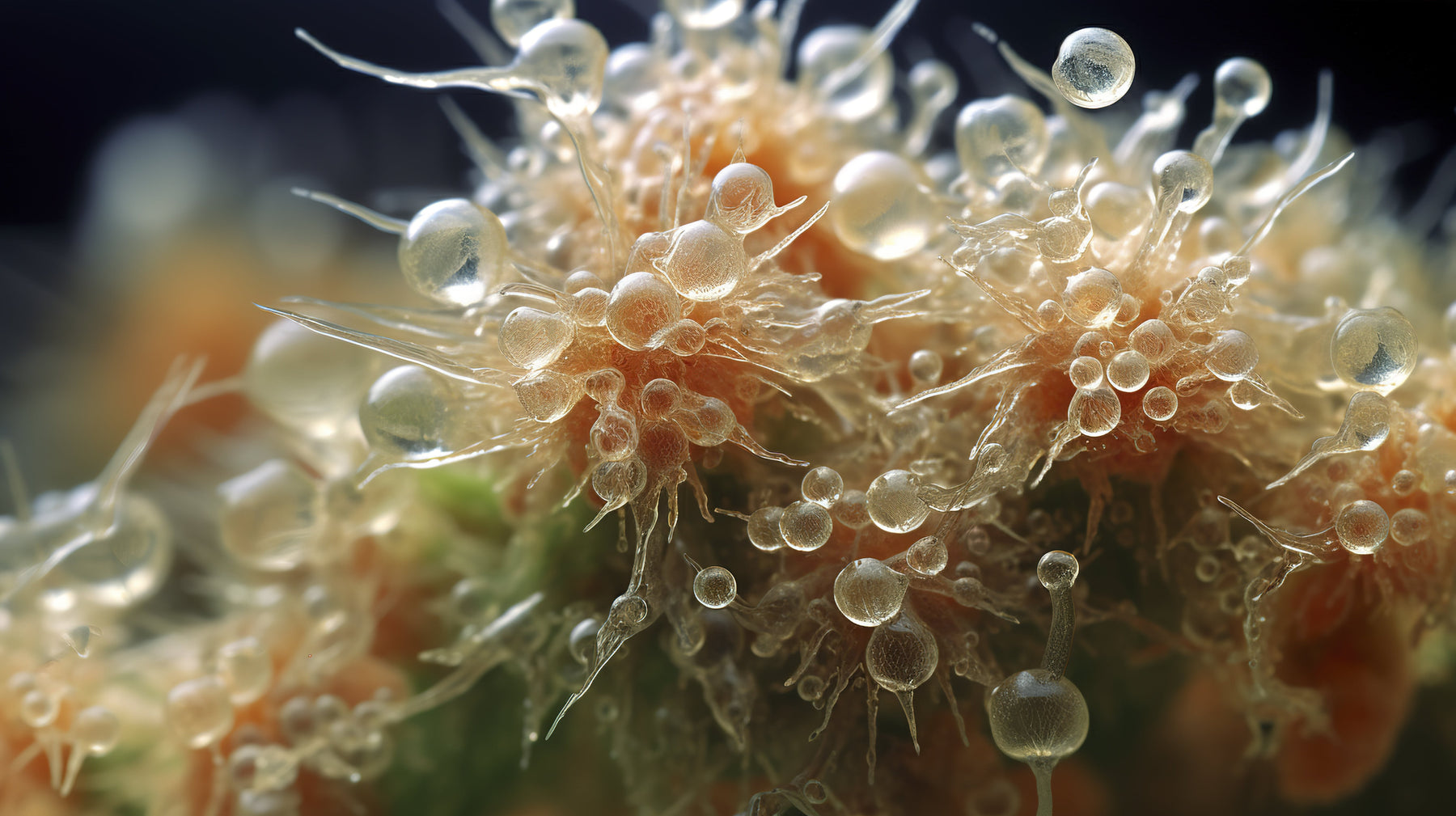
The trichomas in marijuana are resinous glands that produce cannabinoids and terpenes, essential for the aroma, flavor and power of the plant. Visible as crystals, they indicate maturity and quality.
The trichomas, often referred to as the "crystals" or "resin" on the surface of cannabis, are tiny glandular structures that play a crucial role in the definition of the quality and power of the plant. At first glance, they look like a white or translucent dust, but under a trichomas microscope they reveal a fascinating complexity. These tiny appendices are responsible for producing and storing cannabinoids, such as THC and CBD, and terpenes, which confer their characteristic aromas and flavors to cannabis.
The importance of trichomes goes beyond their contribution to the psychoactive and therapeutic compounds of cannabis. The state of maturity of the trichomas Maria is a key indicator for growers, pointing out the optimal moment to harvest. Trichomas ready to harvest indicate that the plant has reached its maximum point of power and quality. On the other hand, past or too mature trichomes can mean a decrease in the quality of the final product. Therefore, detailed observation of trichomes, many times with the help of a microscope, is an essential practice in the cultivation of cannabis.

Anatomy of trichomes
Cannabis trichomes, tiny but deeply significant structures, have a specialized and diverse anatomy. These glandular appendages can be classified mainly in two categories: captained and non -captured trichomes.
Captured Trichomas
These are the most prominent and relevant trichomes for cannabinoid production. They are divided into two main subtypes:
- Sesiles Capitted Trichomas: These trichomes have a smaller structure and a glandular head that sits directly on the surface of the plant. Although they produce cannabinoids, their concentration is lower compared to pedunculated captains.
- Pedunculated captured trichomes: They are the largest and most visible, especially under a trichomas microscope. These trichomes are made up of a long stem (peduncle) that supports a spherical glandular head. This head is where cannabinoids and terpenes are synthesized and stored. When cultivators talk about trichomes ready to harvest, they generally refer to the state of these trichomes.
Not captured trichomes
These are much smaller and less visible. They do not have a distinctive glandular head and its main function is not related to cannabinoid production. Although less prominent, they contribute to the defense of the plant against pests and external elements.
In addition to these categories, there are a variety of less known trichomes, each with its own function and structure. However, in the context of cannabis and its desirable properties, pedunculated captains trichomes are the most studied and valued, due to their crucial role in the production of the precious cannabinoids and terpenes.
The detailed observation of these trichomes, especially their color and structure under the microscope, allows to determine not only the maturity and the optimal moment for the harvest, but also to anticipate the profile of cannabinoids and terpenes of the plant, essential elements to understand the power and effects of cannabis.
Trichom functions
The trichomas in cannabis are not merely microscopic ornaments; Its function is vital for the plant and highly valued by growers and consumers. These tiny structures play a central role in the production of the most significant compounds of cannabis: cannabinoids and terpenes.
Cannabinoid production
The trichomes are the biochemical factories of cannabis, responsible for the synthesis of cannabinoids such as THC (Tetrahydrocannabinol), CBD (Cannabidiol), and many others. In the glandular head of cannabinoid trichomes, especially in pedunculated captains, there are the secretory cells that synthesize these compounds from biochemical precursors. The THC, known for its psychoactive effects, and the CBD, famous for its therapeutic properties, are the most studied and sought after.
The concentration and profile of cannabinoids can vary significantly according to the maturity of trichomes. For example, mature trichomes indicate a high concentration of THC, while past trichomes can point out a degradation of THC in CBN (cannabinol), which has different effects. This is the reason why the moment of harvest, determined by the state of cannabinoid trichomes, is crucial for the final cannabinoid profile of the plant.
Terpenos generation
The terpenes are organic compounds that give cannabis their characteristic aromas and flavors. From citrus and fruity to terrifying and amaderades, the diversity of aromas in the different varieties of cannabis is due to the complex mixture of terpenes produced in the trichomes. In addition to influencing the sensory experience, it is believed that the terpenes interact with cannabinoids to modulate their effects, a phenomenon known as the entourage effect.
The production of terpenes in the trichomes is influenced by several factors, including plant genetics, cultivation atmosphere, and the moment of harvest. Mature trichomes, observable under a trichomas microscope, are indicative of a well -developed terpenos profile, which translates into a more intense and defined aroma and flavor.

Trichomas and cannabis quality
The quality and power of cannabis are intrinsically linked to the appearance and state of trichomes. These tiny structures are not only visual indicators of the maturity and health of the plant, but they are also fundamental in determining the concentration and balance of cannabinoids and terpenes.
Quality and power indicators
- Coloration: Maria trichomas are going through a maturation process that is reflected in its color. Initially they are transparent, a sign that the plant is still developing its compounds. As they mature, they become bedroom or whitish, indicating a greater concentration of THC. Finally, they acquire an amber color, which suggests a high level of CBN and a decrease in THC. The proportion of bedroom and amber trichomes is key to determining the power and type of effect that cannabis will produce.
- Structure: Trichomas must have a well -formed glandular head and a distinctive stem. Mature and well developed trichomes are a sign of a healthy and powerful plant.
Observation and analysis methods
- Use of microscopes: For a precise evaluation, a trichomas microscope is used. These devices allow to observe in detail the structure and color of the trichomes, which is essential to determine the optimum harvest moment and the general quality of cannabis. Microscopes can vary from hand models to more sophisticated equipment.
- Macro photography: Macro photography is another technique used to analyze trichomes. Through high resolution images, cultivators can closely examine the maturity and health of trichomes, even without having access to a microscope.
- Visual inspection: Although less precise, visual inspection with a magnifying glass can provide a general estimate of the state of trichomes. However, for large -scale production purposes or to ensure specific quality and power, the use of more precise tools is recommended.
Harvest and trichomes
The relationship between the state of trichomes and the optimal harvest moment is one of the most crucial aspects in the cultivation of cannabis. The detailed observation of the trichomes provides invaluable information about the maturity of the plant and, therefore, about the best time to harvest to obtain maximum potential in terms of power, effect and flavor.
Relationship between trichomes and harvesting moment
- Clear or transparent trichomes: They indicate that the plant is not yet mature. Harvesting at this stage will result in a less powerful cannabis and with fewer psychoactive effects.
- Bedroom or white trichomes: This is the point where the plant has reached its maximum concentration of THC. The harvest at this stage produces cannabis with high power and pronounced psychoactive effects.
- Amber trichomas or brown: THC's conversion to CBN is more evident in this phase. Harvest when most trichomes are at this stage will provide cannabis with more relaxing and sedative effects.
Techniques to identify trichomas ready to harvest
- Observation with microscope: The most accurate technique to determine the state of trichomes is by using a trichocomas microscope. This allows a detailed evaluation of the color and structure of trichomes, which is essential to identify the optimal harvest moment.
- Jewelry magnifying glass: A more accessible alternative to microscope is the jeweler, which although it does not provide so much precision, may be sufficient for a general estimate of the maturity state of the trichomes.
- Macro photography: Macro photography allows cultivators to document and analyze trichomes more detailed. This technique can be especially useful to keep a record of the progress of the ripening of trichomes over time.
- Experience and knowledge: Over time, cultivators develop an intuitive sense to identify the right time of harvest based on the general appearance of trichomes and the plant. However, this ability is perfected with the experience and a deep knowledge of the specific cannabis varieties they are cultivating.

Extraction and trichomes
The extraction in the cannabis world refers to the process of separating the rich trichomes in cannabinoids and terpenes of plant matter. Since the trichomes are the main sources of the active compounds of cannabis, their role in the production of concentrates and oils is fundamental. The quality of the final extraction product depends largely on the quality and status of the trichomes used.
Extraction methods centered on trichomes
- Mechanical extraction: This method includes techniques such as dry sieve and cold pressing (Rosin). Both methods are based on the physical separation of the trichomes of plant matter, without the use of solvents. Dry sieve uses screens from different microns to filter trichomes, while cold pressing applies heat and pressure to extract resin compounds.
- Extraction with solvents: Methods such as extraction with supercritical, butane (BHO) or ethanol use chemical solvents to dissolve and separate trichomes from plant matter. These methods can extract a broader spectrum of cannabinoids and terpenes, but require specialized equipment and purification processes to eliminate solvents residues.
- Water and ice extraction: Known as "Water Hash" or "Bubble Hash", this technique uses cold water and ice to separate the trichomes from the plant. The trichomes become fragile in low temperatures and separate easily, then leaked through bags with different mesh sizes.
Importance of trichomes in the production of concentrates and oils
- Concentration of cannabinoids and terpenes: Trichomas are the main source of cannabinoids and terpenes that are sought in concentrates and oils. A high quality extraction product requires ripe and high quality trichomes to guarantee a rich and powerful profile of these compounds.
- Diversity of products: The extraction of trichomes allows the creation of a variety of products, from Shatter, Wax, and oils to resins and tinctures. Each extraction method can produce a specific type of concentrate, offering a wide range of textures, powers and experiences.
- Purity and power: Extraction focused on trichomes can produce products with high purity and power. These concentrates offer a more intense and direct experience of the effects of cannabis, which is especially valuable for therapeutic purposes and for users with high tolerance.